
Grey hat link building (also spelled gray hat link building) is the practice of getting backlinks with methods that sit between safe and against the rules. The tactics are not always banned by name, but they are often built mainly to boost rankings, and that is where the risk starts. They can work for a while, then fail when Google’s systems or reviewers notice the pattern.
In this guide I explain what grey hat link building is, how it differs from black hat link building, and the most common examples. I also show how to spot grey hat links in your own profile and what to do if you already have them.
If you want the safe approach instead, read my guide to white hat link building. If you are new to the topic, start with backlinks in SEO.
In this guide
- What is grey hat link building?
- Grey hat vs black hat link building
- Examples of grey hat link building
- Why grey hat link building is risky
- How to spot grey hat links in your backlink profile
- What to do if you already have grey hat links
- Questions to ask before you buy links
- Safer alternatives to grey hat link building
- Conclusion
What is grey hat link building?
Grey hat link building covers link tactics that are not clearly safe and not clearly spam. Google does not use the term itself. It talks about link spam, which it defines as creating links to or from a site “primarily for the purpose of manipulating search rankings.”
That definition is the key. A link that exists because it helps a reader is normal. A link that exists only to pass ranking value is a problem. Many grey hat methods fall into the second group, even when the seller calls them safe.
The word “grey” is really a warning that the rules are unclear and the risk is growing. That is why most people who offer link building services for the long term avoid these methods.
Grey hat vs black hat link building
The two are close neighbours. The difference is mostly about how openly the tactic breaks the rules and how much damage it can do.
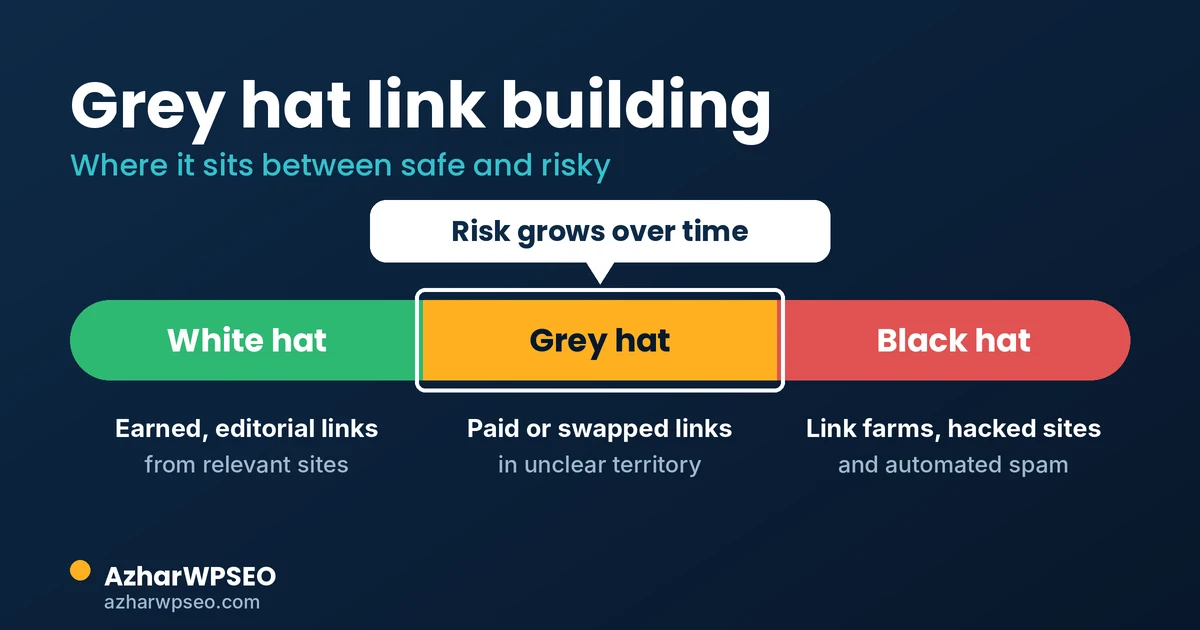
- Grey hat: uses real sites and real pages, but pushes the limits. Examples are paid guest posts with ranking-passing links and large link swaps.
- Black hat: uses deception or automation. Black hat link building includes link farms, private blog networks built only to pass links, hacked sites and automated spam.
Grey hat can slide into black hat when it is done at scale. For the safe end of the scale, see my list of safe link building methods.
Examples of grey hat link building
Several of these appear in Google’s spam policies. Others are not listed by name but follow the same pattern.
- Paid links with no rel attribute: buying a link meant to pass ranking value. Google says paid links are fine when they are marked with rel=”sponsored” or rel=”nofollow”.
- Large link exchanges: “link to me and I will link to you” at scale, or partner pages built only for cross-linking.
- Keyword-rich anchors in guest posts: articles or press releases spread across many sites with optimised anchor text.
- Bulk placements on sites that sell links to anyone: a niche edit on a genuine, relevant article is different, but a bought batch from a link marketplace is not.
- Expired domains: buying an old domain only to redirect or reuse its links.
- Low-quality directories and bookmark sites: links that add no value to a reader.
- Footer, widget or forum signature links: links placed in templates or comments so they appear on many pages.
Why grey hat link building is risky
Google says it finds spam through automated systems and, when needed, human review. It also says that sites which break its policies may rank lower in results or not appear at all. A human review can lead to a manual action, which shows in Search Console.
The risk grows over time. One odd link is rarely a problem. A pattern of paid or swapped links is easy to see, and the more you build, the clearer the pattern becomes. A site that depends on organic traffic stands to lose the most.
Quick results are the other trap. A grey hat link may move a page up for a few weeks, and then a later update or review can remove the benefit. By then the money is spent and the links are hard to remove.
How to spot grey hat links in your backlink profile
If you inherited links from an old agency or freelancer, check the profile before you build anything new. Open the Links report in Google Search Console to see your top linking sites and top linking text. A backlink tool shows more detail.

- A sudden spike of links in a few days.
- Repeated exact-match anchors, such as the same keyword phrase on many links.
- Unrelated sites that have nothing to do with your topic.
- Sites that openly sell guest posts or “sponsored” placements to anyone.
- Footer, widget or forum signature links that appear on many pages.
None of these proves a violation on its own. Several together are worth a closer look. An SEO audit can review your links and tell you which ones help, which are harmless, and which may need attention.
What to do if you already have grey hat links
Do not panic. Many sites have a few weak links, and Google says its systems can usually tell which links to trust. Work through these steps in order:
- Stop building them. Pause any plan that buys or swaps links.
- List the links. Export your links from Search Console and sort them by risk.
- Ask for changes. Contact the site owner to remove the link or add rel=” sponsored” to paid ones.
- Use disavow with care. Google calls the disavow tool an advanced feature and says most sites do not need it. It is meant for large numbers of spammy links that have caused, or are likely to cause, a manual action.
- Check manual actions. Look at the Manual actions report in Search Console and follow its steps if there is a notice.
- Replace them with better links. Earn relevant links through real content instead.
Questions to ask before you buy links
If you hire help, ask direct questions. A good provider answers them clearly. Compare these answers with my notes on questions to ask an SEO agency.
- Where exactly will the links be placed, and can I see examples?
- Do these sites sell links to anyone who pays?
- How many links will you build each month, and how do you choose anchor text?
- Will paid placements carry the right rel attribute?
- Do you send a report listing every live link?
- What happens if a link is removed?
You can see how my link building services work and what each plan includes on the pricing page.
Safer alternatives to grey hat link building
Safe link building is slower but it lasts. Focus on guest posts on relevant sites, digital PR, useful resources, broken link outreach and local partnerships. These give links a reason to exist, which is what search engines want. My guides on the importance of link building in SEO and white hat link building explain each method step by step.
Conclusion
Grey hat link building promises fast results, but the risk grows with every link you add. Check your profile, stop shortcuts and build links that earn their place. Pair them with a healthy site and good pages, and your rankings can grow without worrying about the next review.
If you would like me to look at your links, request a free quick audit and I will tell you what I would fix first.
Frequently asked questions
What is grey hat link building?
Grey hat link building means getting backlinks with tactics that sit between safe and against the rules, such as paid links without the right attribute, large link swaps or bulk placements on sites that sell links to anyone.
Is grey hat link building safe?
No. It may work for a short time, but Google says sites that break its spam policies may rank lower or not appear at all. The risk grows as you build more links.
Is guest posting grey hat?
Not by itself. A guest post on a relevant site that gives readers real value is a normal white hat method. It becomes risky when posts are mass-produced with keyword-rich anchors or bought from sites that sell links to anyone.
What is the difference between grey hat and black hat link building?
Grey hat pushes the rules using real sites. Black hat uses deception or automation, such as link farms, hacked sites and automated spam, and carries a higher chance of a penalty.
Can I fix grey hat links on my site?
Yes. Stop building them, ask site owners to remove or mark them, use the disavow tool only if you have a manual action or a large spammy pattern, and build better links over time.
Get your free SEO audit
Send your website URL and I will reply with the top issues holding your rankings back.