
White hat link building is the practice of earning backlinks in ways that follow Google’s guidelines: real content, relevant websites and links that a person would actually click. It is slower than buying links in bulk, but it is the approach that protects your site. If your business depends on Google traffic, one penalty can cost far more than any shortcut ever saved.
In this guide I explain what white hat link building is, how it differs from risky tactics, and seven safe methods you can use today. I also cover how to judge a link, the mistakes I see most often, and how long results usually take. Whether you build links yourself or hire someone, you will know what to look for.
Along the way you will see the main ideas behind seo link building, from why backlinks in seo still matter to what link building packages should include.
In this guide
- What is white hat link building?
- Why backlinks in SEO still matter
- White hat vs grey hat vs black hat link building
- How to judge a good backlink
- Method 1: Guest posts on relevant sites
- Method 2: Niche edits
- Method 3: Digital PR and brand mentions
- Method 4: Broken link building
- Method 5: Resource page outreach
- Method 6: Linkable assets: guides, data and tools
- Method 7: Local links and partnerships
- Anchor text: keep it natural
- White hat link building mistakes to avoid
- How many links do you need, and how long does it take?
- Link building packages and services: what to look for
- DIY or hire a link building specialist?
- Conclusion

What is white hat link building?
White hat link building means earning links through methods that search engines approve of. The links come from real websites, sit inside useful content and exist because they help the reader. Nobody is tricked, and nothing is hidden.
A simple test: would the link still make sense if search engines did not exist? A restaurant review site linking to a local chef, or an industry blog linking to a helpful guide, passes that test. A random footer link on a site that sells links to anyone does not.
White hat link building is also the foundation of any serious plan. You can read how I apply it for clients on my link building services page.
Why backlinks in SEO still matter
Search engines use links to discover pages and to judge which sites can be trusted. When many relevant websites link to a page, Google treats it as more reliable. That is why backlinks in seo are still one of the strongest ranking signals, even as search keeps changing.
Links also bring visitors. A link inside a respected article can send people who are already interested in your topic, and those visitors convert better than random traffic.
Backlinks do not work alone. A site with slow pages, indexing errors or thin content will struggle even with strong links. That is why I usually start with a technical SEO and on-page review before building links.
White hat vs grey hat vs black hat link building
The three labels describe how much risk a method carries:
- White hat: earned, editorial links from relevant sites, such as guest posts, digital PR and useful resources.
- Grey hat: methods that sit in a gap, such as aggressive link swaps or placements on sites that clearly sell links. They may work for a while, but the risk grows over time.
- Black hat: link farms, private blog networks built only to pass links, hacked sites and automated spam. These break the rules and can lead to penalties.
Google lists manipulative link practices in its spam policies. If you rely on organic traffic, staying on the white hat side is the safer long-term choice.
How to judge a good backlink
Not every link is worth building. Before you pursue one, check these points:
- Relevance: the site covers a topic close to yours.
- Real audience: the site has real traffic and real readers, not just a long list of guest post offers.
- Editorial placement: the link sits inside useful content, not in a sidebar or footer.
- Natural context: the text around the link explains why it is there.
- Site quality: the site is well written and not stuffed with ads or unrelated topics.
Do not worry if a link is marked nofollow. Google explains how to qualify outbound links with nofollow, sponsored and ugc attributes, and a mixed profile looks natural.
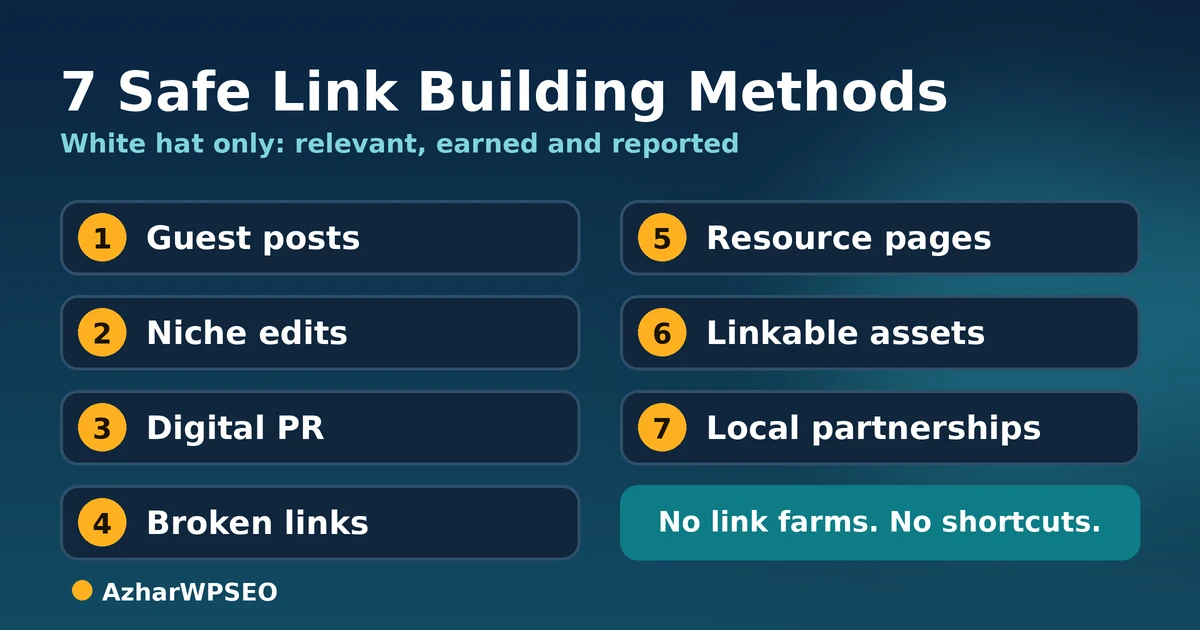
White hat link building techniques and strategies at a glance
These are the seven white hat link building techniques I rely on most. Each one is explained in detail below.
- Guest posts on relevant sites
- Niche edits on genuine articles
- Digital PR and brand mentions
- Broken link building
- Resource page outreach
- Linkable assets: guides, data and tools
- Local links and partnerships
Method 1: Guest posts on relevant sites
Guest posting means writing a useful article for another site in your field, with a link back to a relevant page of yours. Done well, it builds authority and sends real visitors. Done badly, it fills the web with thin articles on sites nobody reads.
Pick sites your customers actually read, pitch an idea that fits their audience, and write something you would be proud to publish on your own blog. Guest posts remain one of the most reliable parts of seo link building because you control the quality of the content.
Method 2: Niche edits
Niche edits add a link to an existing article that already ranks and gets traffic. Because the page is established, the link can pass value quickly. The article must be relevant and the new link must add real value for the reader, such as a better source or a more current guide.
I only use niche edits on genuine articles from real publishers. A link inserted into an unrelated or abandoned page is not a niche edit, it is a risk.
Method 3: Digital PR and brand mentions
Digital PR earns links by giving journalists and bloggers something worth covering: original data, expert comments, a useful tool or a genuine story. When a site mentions your brand, you can ask politely for a link.
Unlinked mentions are an easy win. Search for your brand name, find articles that mention you without linking, and send a short, friendly message asking for a link.
Method 4: Broken link building
Many websites link to pages that no longer exist. In broken link building, you find a dead link on a relevant site, create or point to a good replacement, and let the owner know. It helps them fix a problem, which is why it works.
It takes patience, because most outreach gets no reply, but the links are earned and relevant.
Method 5: Resource page outreach
Many sites keep a page of useful tools, guides or suppliers in their field. If your content genuinely belongs there, ask to be included. The key is to be honest about why your resource helps their readers.
Check that the page is current and that the site is real before you reach out.
Method 6: Linkable assets: guides, data and tools
A linkable asset is something people want to reference: a clear guide, a free calculator, a checklist or a small original study. Other sites link to it because it saves them the effort of explaining the topic.
Building one strong asset and promoting it well can earn more links than ten average blog posts.
Method 7: Local links and partnerships
For businesses that serve a city or region, local seo link building is often the best place to start. Local chambers of commerce, sponsorships, community events, suppliers and local news sites can all link to you, and those links tell Google where you operate.
Combine them with a strong Google Business Profile and accurate listings. My local SEO services page explains how local links and listings work together.
Anchor text: keep it natural
Anchor text is the clickable words of a link. In any talk about seo and backlinks, it gets a lot of attention, because the words around a link help Google understand the page it points to. Natural anchors are usually the brand name, the page title, a plain URL or a short phrase that fits the sentence.
Problems start when every link uses the same exact-match phrase. A real profile has variety, because real writers link in different ways. Google also recommends clear, descriptive link text in its link best practices. A good rule is to let the writer choose the wording whenever possible, and to avoid forcing keywords into every anchor.
When I plan links for a client, I map anchors in advance: some branded, some partial match, some generic and a small share exact match. That keeps the profile balanced and reduces risk.
White hat link building mistakes to avoid
- Buying links in bulk from unknown sellers
- Using the same exact-match anchor text again and again
- Building links to one page only, instead of spreading them across key pages
- Chasing high authority scores and ignoring relevance
- Ignoring technical problems that stop pages from ranking
- Expecting results in days instead of months
If you are unsure about your current links, an SEO audit shows which ones help, which are harmless and which may need attention.
How many links do you need, and how long does it take?
There is no magic number. The right amount depends on your competition and on how many links the sites ranking above you already have. A competitor gap analysis gives you a realistic target for each page.
Most sites see movement in two to four months, but it depends on competition, content quality and how many links are built each month. Steady progress beats sudden bursts, which can look unnatural.
Link building packages and services: what to look for
If you decide to hire help, compare link building services by how they work, not just by price. Good link building packages are clear about what you get each month and how links are chosen.
- A clear list of the methods used, such as guest posts and niche edits
- Examples of the type of sites they work with
- A report listing every live link and the page it points to
- No promise of a fixed ranking
- No long lock-in contract
The same applies to seo link building services from any provider. If a seller cannot explain how links are built, walk away. You can see how my own packages work on the pricing page, or ask for a custom quote if you only need one service.
DIY or hire a link building specialist?
If you have time and are happy to write and send outreach emails, you can build links yourself with the methods above. The hardest parts are consistency and finding good sites.
Need a white hat link building service? If you do not have time for outreach, I build links the same way this guide explains: relevant sites, real content, natural anchors and no paid link packages. Every link is reported with its live URL, so you can check it yourself.
If you would rather spend that time running your business, hiring a specialist can be cheaper than the hours you would spend. Whichever you choose, keep the focus on relevance and quality.
Conclusion
White hat link building is slower than shortcuts, but it is the approach that lasts. Focus on relevance, earn links through real content and keep your profile natural. Combine it with a technically healthy site and good pages, and your rankings can grow without the fear of a penalty.
If you would like help, request a free quick audit and I will tell you what I would fix first.
Frequently asked questions
What is white hat link building?
White hat link building is earning Free backlinks through methods that follow search engine guidelines, such as guest posts on relevant sites, digital PR and useful resources, instead of buying links or using link farms.
Is link building still important for SEO?
Yes. Backlinks are still one of the strongest ranking signals, but they work best together with good content and a technically healthy website.
How long does white hat link building take to work?
Most sites see movement in two to four months, depending on competition, content quality and how many links are built each month.
Are paid links safe?
Paid links that are meant to pass ranking value go against Google guidelines. If a link is paid, it should be marked with the right attribute. Earned, editorial links are the safer choice.
Get your free SEO audit
Send your website URL and I will reply with the top issues holding your rankings back.