

Every website owner wants more links, and most of the offers in your inbox want money for them. The good news is that you can earn free backlinks that are safe, relevant and actually help your rankings. They take more effort than buying a package, but they will not put your site at risk.
In this guide I share the nine free methods I use for my own site and for clients, plus the “free” tactics you should avoid.
In this guide
What makes a free backlink safe?
A backlink is a link from another website to yours. Search engines use links to judge whether people trust a page. If you are new to the topic, start with my guide on backlinks in SEO.
Free backlinks are safe when three things are true:
- The site is relevant. It is about your industry, your city or your audience.
- The link has a reason to exist. A real reader could click it and find something useful.
- You did not trade or pay for it. Google’s spam policies on link schemes are clear that buying, selling or swapping links to manipulate rankings is a problem.
Some free links will carry rel="nofollow" or rel="ugc". That is normal. They still bring visitors and make your link profile look natural.
9 safe ways to get free backlinks
1. Complete your business and professional profiles
Create full profiles on trusted platforms where your website field is allowed: Google Business Profile, LinkedIn, Crunchbase, Clutch, GoodFirms, Gravatar and WordPress.org. Use the same name, the same description and a real photo. These links are easy, and they help search engines understand who you are.
2. Get listed in relevant niche and local directories
Skip the giant “submit to 500 directories” lists. Choose a few directories that real customers in your industry or city actually use, such as your chamber of commerce or a trade association. One relevant listing beats fifty random ones.
3. Write guest posts for relevant blogs
Find blogs in your niche that accept contributors. Pitch a topic their readers need, write a genuinely useful article, and link to your site only where it helps. Never pay for a “guest post” slot, because that is a paid link with a different name.
4. Answer expert quote requests
Journalists and bloggers often look for expert quotes. Free platforms like Qwoted and Featured connect you with them. Answer only in your field, keep it short and specific, and you may earn a mention on a strong site.
5. Fix broken links on other sites
Find resource pages in your niche, check them for dead links, and email the owner. Tell them which link is broken and suggest your page as a replacement if it really covers the same topic. You are doing them a favour, so the reply rate is often better than cold pitches.
6. Turn brand mentions into links
Search for your brand name or your own name in Google. If a site mentions you without a link, send a polite note asking them to add one. People who already mention you are usually happy to help.
7. Publish content people want to cite
Simple checklists, step-by-step guides, free templates and small original data sets earn links on their own. My guide on how to check backlinks for free is an example of a practical page others can point their readers to.
8. Republish your articles with a canonical tag
Platforms such as Medium, Dev.to and Hashnode let you republish an article and set the canonical URL to the original on your site. You reach a new audience, you get a link back, and Google knows which version is the original.
9. Help people in communities
Answer questions on Quora, Reddit and industry forums. Write a full answer first. Add a link only when your page gives more detail than the answer can. Communities ban link droppers fast, and these links are usually nofollow, so think of them as traffic and trust, not ranking power.
Free backlinks to avoid
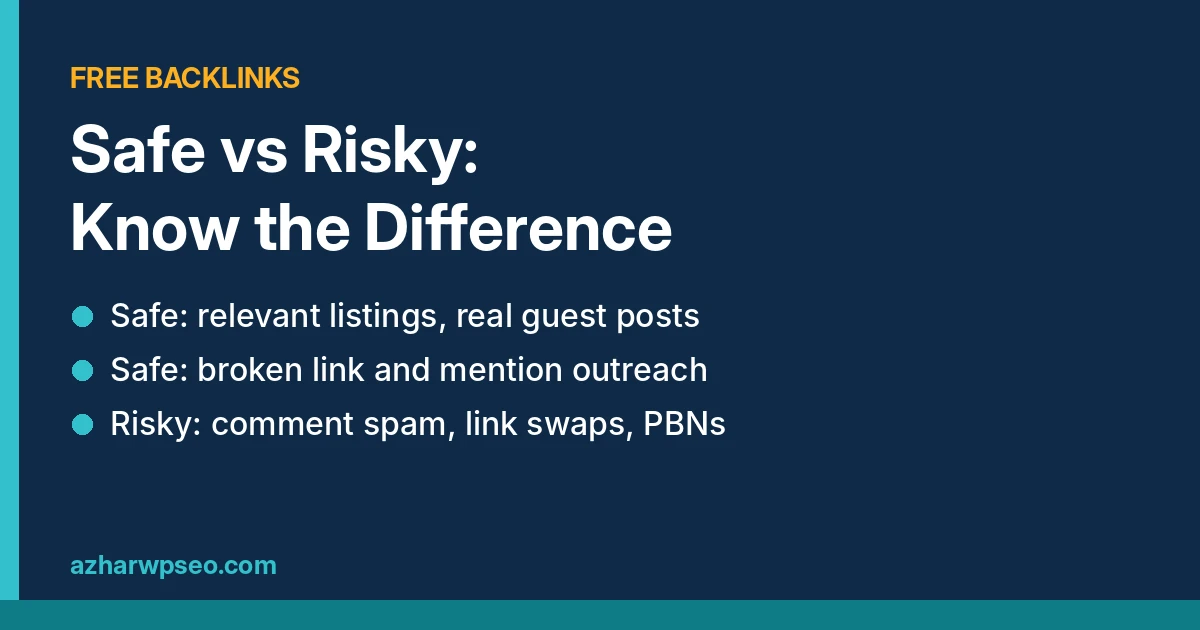
Not every free link is worth having. Avoid these, even when they cost nothing:
- Blog comment and forum signature spam. Dropping links in comments looks spammy and is almost always nofollow.
- Link exchanges. “You link to me, I link to you” schemes at scale are against Google’s guidelines.
- Free PBN or “high DA” link offers. If someone gives you links from a network of sites built only for links, it can hurt you.
- Automated link tools. Software that creates hundreds of profiles or posts in one day leaves a clear footprint.
If you want to see where the line sits, read my posts on white hat link building and grey hat link building.
How to track your new links
Keep a simple sheet with the date, site, page, anchor text and rel value for every link you build. Check each live link by right-clicking it and choosing Inspect. Once a month, open the Links report in Google Search Console to see which of your free backlinks Google has found.
Aim for steady growth. Three to five good links a week looks natural. Two hundred links in one week does not.
FAQ
Are free backlinks safe?
Yes, when they come from relevant sites and you earn them with real profiles, content and outreach. They become risky when they come from spam, automated tools or link schemes.
How many free backlinks should I build per month?
There is no magic number. For a small business site, a steady 10 to 20 relevant links a month is a strong pace. Quality and relevance matter more than the count.
Do nofollow links help SEO?
They do not pass ranking value the same way a followed link can, but they bring visitors, build brand trust and keep your link profile natural. A healthy profile has both.
How long until free backlinks improve rankings?
Usually weeks to a few months. Google first has to find the link, then re-assess your page. Keep building and keep improving the page in the meantime.
Not sure where your site stands? I will check your backlinks, on-page SEO and technical issues and send you a clear list of what to fix first.